From simulation to strategy in modern healthcare
Healthcare has always balanced science with uncertainty. Clinicians make decisions based on population-level evidence, clinical guidelines, and experience—yet every patient is biologically unique. What if medicine could test treatment options on a virtual version of you before applying them in the real world?
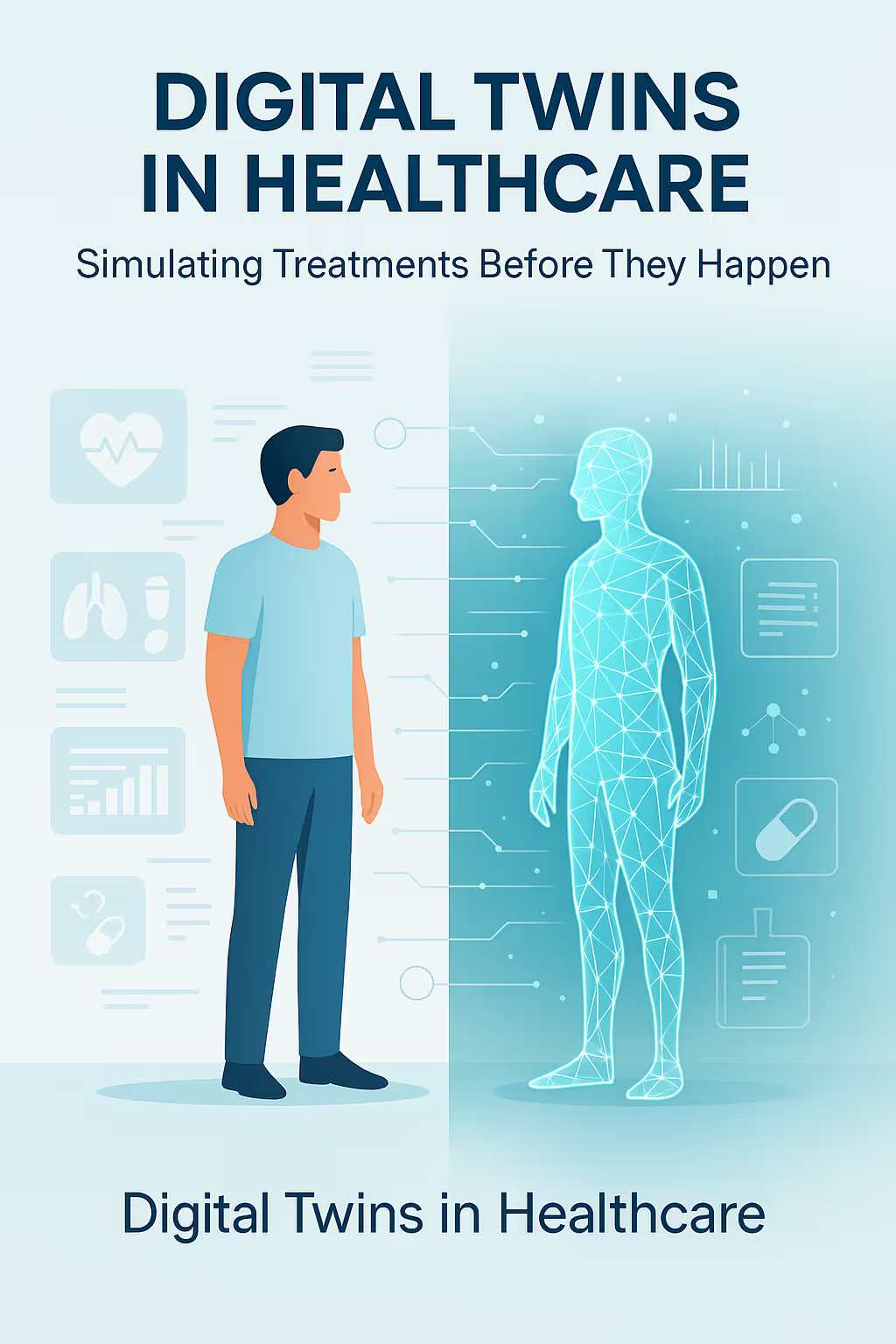
This is the promise of digital twins in healthcare: computational replicas of individual patients that simulate how a body, organ, or disease may respond to interventions. Once a concept borrowed from aerospace and manufacturing, digital twins are now emerging as a transformative force across medicine, from oncology and cardiology to drug development and health system planning.
Recent advances in artificial intelligence (AI), mechanistic modelling, and real-world data integration are accelerating this shift. As a result, healthcare is moving from reactive treatment towards predictive, personalised, and proactive care.
What is a digital twin in healthcare?
A digital twin is a dynamic virtual model of a physical system that is continuously updated using real data. In healthcare, this system may represent an individual patient, a disease process, or even a population cohort.
Unlike static models, digital twins evolve over time. They integrate multiple data streams—such as electronic health records (EHRs), medical imaging, genomics, physiological signals, and lifestyle data—to simulate biological processes and forecast outcomes under different scenarios (Vengathattil, 2025).
In simple terms, a healthcare digital twin allows clinicians and researchers to ask:
“What is likely to happen if we intervene in this way, for this patient, at this point in time?”
What can patient-specific digital twins do?
1. Predict disease progression
Digital twins can model how a disease is likely to evolve in an individual, rather than relying on average population trajectories. This is particularly valuable for chronic and complex conditions, where progression varies widely between patients.
For example, disease-specific twins in oncology can simulate tumour growth, mutation pathways, and treatment resistance, helping clinicians anticipate progression earlier and adjust treatment strategies accordingly (Vengathattil, 2025).
2. Simulate treatment and surgical outcomes
One of the most promising applications of digital twins is treatment simulation. Before a drug is prescribed or a surgical intervention is undertaken, multiple options can be tested virtually to estimate likely outcomes and risks.
In oncology, early studies show that digital twin–based models have improved the accuracy of tumour response prediction from approximately 75% using traditional methods to around 88% when AI-driven simulation is applied (Vengathattil, 2025).
In cardiology, similar approaches have increased the accuracy of predicting post-surgical recovery from around 70% to over 80%, enabling better patient selection and risk stratification.
These gains are not incremental—they represent a step change in how evidence can be applied at the individual level.
3. Accelerate drug development through virtual trials
Digital twins are also reshaping pharmaceutical R&D. By simulating patient responses in silico, researchers can test hypotheses, dosing strategies, and inclusion criteria before running costly physical trials.
Virtual trials may:
- Reduce the number of failed late-stage trials
- Identify responder sub-populations earlier
- Shorten development timelines from years to months
This has profound implications for rare diseases, oncology, and precision medicine, where recruitment is challenging and biological heterogeneity is high (Viceconti et al., 2021).
Why digital twins matter for healthcare systems
Beyond individual patients, digital twins can be deployed at system and population levels. Health services can model care pathways, hospital capacity, and policy interventions under different demand and funding scenarios.
For payers, regulators, and policy-makers, this creates a new evidence layer: one that complements real-world evidence with forward-looking simulation.
From a strategy perspective, digital twins represent a shift from:
- Retrospective analysis → prospective planning
- Average effects → individualised outcomes
- Trial-and-error → simulated optimisation
The challenges: what stands in the way?
Despite their promise, digital twins are not without challenges.
Data integration and quality
Building accurate digital twins requires harmonised, high-quality data across clinical, biological, and behavioural domains. Fragmented systems and inconsistent standards remain major barriers.
Computational cost and complexity
High-fidelity simulations are computationally intensive. Scaling digital twins across populations requires significant infrastructure and expertise.
Privacy, ethics, and governance
Patient-level digital replicas raise legitimate concerns around consent, data ownership, bias, and transparency. Robust governance frameworks will be essential to maintain trust and regulatory compliance (European Commission, 2022).
Are we ready for virtual patients?
Digital twins are unlikely to replace clinicians. Instead, they will increasingly act as decision-support systems—augmenting human judgement with probabilistic insight.
Much like weather forecasting evolved from simple models to highly accurate simulations, healthcare is entering an era where what-if questions can be tested safely before real-world consequences unfold.
For organisations operating at the intersection of healthcare, analytics, and strategy, digital twins are not a distant concept. They are an emerging capability that will shape how evidence is generated, interpreted, and acted upon.
The question is no longer whether virtual patients will influence care—but how quickly health systems, regulators, and industry adapt to this new paradigm.
What this means for healthcare analytics
At Social Analytics, we see digital twins as part of a broader shift towards simulation-led decision-making. When combined with behavioural data, network analysis, and advanced forecasting techniques such as Monte Carlo simulation and diffusion modelling, digital twins offer a powerful lens for understanding complexity before it unfolds.
As healthcare decisions grow more interconnected—and the cost of error increases—tools that reduce uncertainty will become indispensable.
References
European Commission (2022) Ethics and governance of artificial intelligence in healthcare. Brussels: European Commission.
Viceconti, M., Hunter, P. and Hose, R. (2021) ‘Big data, big knowledge: big data for personalized healthcare’, IEEE Journal of Biomedical and Health Informatics, 25(3), pp. 1046–1054.
Vengathattil, S. (2025) ‘Advancing healthcare systems with generative AI-driven digital twins’, International Journal of Innovative Science and Research Technology, 10(4), pp. 1678–1688.

Ready to explore further?
Let's discuss how these insights apply to your organisation.